Monday, March 31, 2014

Got Air?

Librarydoor Post repeated here for our local use:
From time to time I am asked about the "research" behind the efficacy of the school librarian.   I want to take a quick minute to post some of the best resources here for those that may need to share these with budgetary decision makers.  (Listed below) 

In this issue of Scholastic's Administrator, I have a short article entitled: Your Hidden Asset.  Let's hope we're not too hidden! (I did not choose the title).  Now, we know that too many administrators just don't frequent your library doors, and Scholastic meant that title figuratively, but let's make it our goal to insure we are seen and heard.   The research will not do you much good if you are not connecting to the classroom, kids, and being visible with your principal.   Consider some Spring SMART goals for visibility.  Here are a few examples:
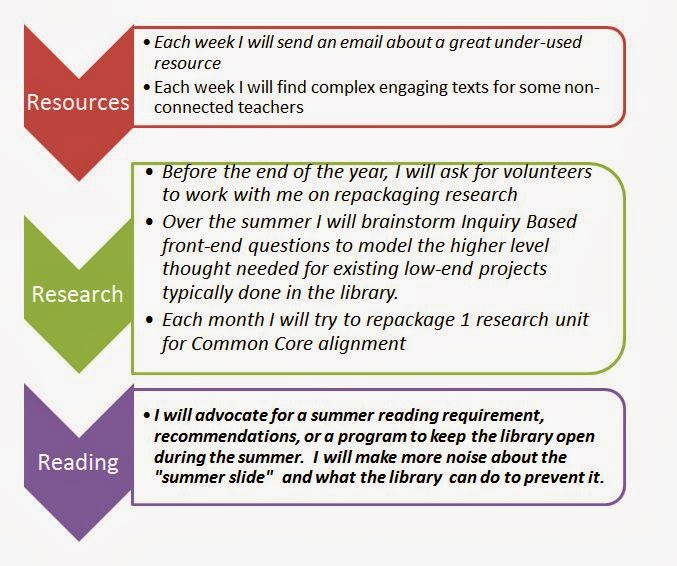
One of our local elementary librarians, Jen , advocated for bags to enable her to send home 5 books with each student this summer.  She works in a high-needs district and commented, "I know some will be lost, but I don't care.  We have to work to reduce the summer slide and I know many kids have no books at home."   She said she is planning on telling the kids to share and to bring them back.   This will be the first year of this program so it will be interesting to see the data on what is lost.  Dare we say it will be a small cost compared to the lost reading ground retained?   

To find other ways to be seen and hear, order a copy of Make a Big Impact @ Your School Board Meeting.   - From Libraries Unlimited. 

Here are a list of the white papers for advocacy and more: 

  • American Association of School Librarians (n.d.). Strong School Libraries Build Strong Students.  Click here 

  • American Association of School Librarians (2012).  School Libraries Count:  National Longitudinal Study of School Library Programs.    A report of the annual online survey of school library programs in the United States. Findings  indicate that despite cuts in many areas, school library programs remain consistently strong.  However, the survey also indicated that the number of computers outside of the library with networked access to services has significantly increased.   The trend is to increase remote access  to library licensed databases.

  • American Library Association (2007). Libraries Connect Communities: Public Library Funding and  Technology Access Study 2006-2007.    This survey of technology access in libraries throughout the United States demonstrates that  technology is attracting larger numbers of people to public libraries each year. It includes  information on children as consumers of technology, especially as users of databases that help with  homework.

  • American Librarian Association (n.d.). Add It Up: Libraries Make the Difference – Talking Points. These advocacy documents provide readers with talking points in favor of funding of public and school libraries. Public library  School library
  • Center for International Scholarship in School Libraries (2010; 2011).  The New Jersey Study of  School Libraries:  One Common Goal-LearningExecutive summaries of an intense two-phase study of school libraries in the New Jersey educational  program indicating that libraries and librarians contribute to the intellectual life and development of students in complex and diverse ways.

Monday, March 24, 2014

TDQ Webinar today at 3:00

Here are the link to the handouts for our TDQ (Text Dependent Questions)  webinar today @ 3:00.   This short 30 minute webinar will lay the basics for understanding TDQ's - We are not expecting a large crowd today as this was in response to a few questions I fielded.   Feel free to join us if you are reading this! :)  (Limit 35 "seats")


  • Bring a couple of short fiction or nonfiction books that you might typically use in your "fixed" library instructional time.  
  • Be sure to print out the TDQ handout below.  The rubric you can print if you need it also. 


    pdfTDQ's(PDF -291 KB) 1 page primer on TDQ's
-------------------------------------------------------
Meeting information
-------------------------------------------------------
Topic: What's the scoop on TDQ's?
Paige Jaeger changed the time for this online meeting.

Topic: What's the scoop on TDQ's?
Date: Monday, March 24, 2014
Time: 3:00 pm, Eastern Daylight Time (New York, GMT-04:00)
Meeting Number: 594 785 788
Meeting Password: library


-------------------------------------------------------
To join the online meeting (Now from mobile devices!)
-------------------------------------------------------
1. Go to https://wswheboces.webex.com/wswheboces/j.php?MTID=m40fcec96f76cba74b59013a1176f8bd6
2. If requested, enter your name and email address.
3. If a password is required, enter the meeting password: library
4. Click "Join".

To view in other time zones or languages, please click the link:
https://wswheboces.webex.com/wswheboces/j.php?MTID=maf955dad4c4c0b3436abef0527184ebd

-------------------------------------------------------
To join the audio conference only
-------------------------------------------------------
US TOLL: 1-650-479-3207

Access code:594 785 788

-------------------------------------------------------
For assistance
-------------------------------------------------------
1. Go to https://wswheboces.webex.com/wswheboces/mc
2. On the left navigation bar, click "Support".

You can contact me at:
pjaeger@wswheboces.org
1-5185813700

To update this meeting to your calendar program (for example Microsoft Outlook), click this link:
https://wswheboces.webex.com/wswheboces/j.php?MTID=m19585a58b89a34579ec00646bb289449


WebEx will automatically setup Meeting Manager for Windows the first time you join a meeting. To save time, you can setup prior to the meeting by clicking this link:
https://wswheboces.webex.com/wswheboces/meetingcenter/mcsetup.php


The playback of UCF (Universal Communications Format) rich media files requires appropriate players. To view this type of rich media files in the meeting, please check whether you have the players 

Monday, March 17, 2014

Library Report Cards....Ugh. What's should I do?

If you are asked to consider “grading” in the library then you have to carefully consider what you are teaching.   Whether or not librarians "grade" is a local decision. 


Here are some thoughts we have shared locally: 

Have simple “goals” per grade level, but have them be aligned to CCSS or the Empire State Fluency Continuum.  That you can point to benchmarks you are measuring. Pick from the best few per grade, as suggested in the chart below which we locally chose because they align with the CCSS standards.   

By limiting the “assessment points”, you leave yourself enough room for creativity and flexibility to address other things.  Assess skills of value.  Do NOT assess things like “Dewey” which have negative value in administrator’s eyes.  Word skills for the 21st Century, such as “How is information organized?”  That way you sound “relevant” and “current.”    

If someone asks you about these bullets, they are intended to produce “College and Career Ready” graduates who are ready to research to build and present knowledge.     


Grade Level
Empire State Information Fluency Continuum  grade level benchmarks
 aligned with the CCSS:

K
* Understands the basics of a book
* Distinguishes between fact and fiction
1
* Briefly summarizes facts
* Asks "What do I wonder about now" questions
2
* Asks Open-ended questions (wonder questions)
* Presents the main idea and supporting details
3
* States the main idea
* Searches online catalog to locate information
4
* Identifies keywords for research
* Students will summarize  information to answer questions
* Students will organize ideas appropriately
5
* Uses appropriate material to answer questions
* Assesses questions to determine which can be answered by simple facts, which cannot be answered and which would lead to an interesting inquiry
6
* Draws conclusions based on evidence
* Draws inferences from text
7
* Uses facts and opinions responsibly
* Analyzes information to form a hypothesis
8
* Students will recognize Point of View
* Draws conclusions based on information
9
* Identifies keywords and synonyms for searching
* Students can mind-map ideas 
10
* Understands advanced web searches
* Draws conclusions based on evidence
11-12
* Develops own Point of View and supports with evidence


Some people have been asked to grade: skill, effort and behavior.  That is like saying, “I don’t have curriculum.”  Just remember the “skill” is your curriculum.

Have students self-assess with “I can” checklists per grade level.   Here are some random I cans:

____I can find a book
____I can ask open-ended questions which lead me to investigation
____I can identify an author
____I can use the Opac
____I can identify my keywords
____I can find evaluate a source for credibility
____I can tell you how information is organized
____I can teach my friend how to write a good book review
____ etc.

If you have a bookmark paper per quarter, you will have self-assessment measuring.  Why not let everyone get an “A”?   The state wants us to eliminate all unnecessary testing.  Therefore, Heaven forbid you give a test to get a grade.  The I can checklists will give you the opportunity to disguise assessment in self-direction.  – Color Code them, red, yellow and green giving “steps” of success. 

Remember:  Our goal is college and career readiness—not giving grades.   


Wednesday, February 12, 2014

Raising eReaders - Rising Above Reluctancy

Hello Local Librarians! 

As I sit here and listen to the LMC Webinar, sponsored by Overdrive, but really on "eBooks" - I remembered that I hadn't posted our slides from the AASL presentation that we gave in Hartford.  

This presentation spotlights great uses of our Overdrive Library with special education, reluctant readers, and more!  Enjoy this spotlight, if you missed AASL13. 

Tuesday, January 21, 2014

Librarian APPR -Seven Areas to Consider

According to NYSED,  there are 7 standards we should keep in mind as we strive to do our best -- To be the best librarian we can be for the sake of student achievement --for the sake of preparing the next generation to run the world.   


In our day and age of assessment, observation, and strategic academic planning, it will benefit us to examine the 25 lines in our NYSED  approved Librarian APPR rubric.   This may be the measure by which all NYS librarians are evaluated in the future.  Using this rubric is now, this is a local decision, but there are queries currently in the State Education Department for this to be approved as one option for the total 100 point measure - thus eliminating the need for librarians to get a growth measure from a S.L.O.

As you read this document,  please ask yourself:   If I were being observed,  

  •  what "evidence" will my principal "see' (i.e. observation)  that proves I have carefully considered this line?    
  • what evidence could I offer to him to show him I "tried."   If you are operating in a silo school where no one collaborates, have a portfolio of evidence handy with printed out emails asking teachers if they need your help to, "Research to build and present knowledge."  
As we piloted our APPR document, some feedback was that "I can't collaborate, if I'm not invited into the conversation."   Or,  "I am not included in grade-level planning meetings."   Or,  "I am not privy to the ELA assessment item analysis to see target areas for instruction.  
We have told our librarians locally to inquire with their building principals about "item analysis"  or the assessment "data"  to see where you could support building level goals.  One librarian was new in a K-12 school and she shared that when she approached her principal with that question, he was surprised.   No librarian had ever asked him that before.   Not a bad way to start your "new job" off on the right foot! 

The key is to consistently try. I suspect that if you consistently try, you can't be found "ineffective" in any area where you are "asking" for teacher support, collaboration, suggesting materials in library emails and more.   One librarian recently decided to create a smore.com flyer for her "news" and shared that in the first 15 minutes, she had 35 views.  That's data for her portfolio to support area 6 - Collaboration and Professional Responsibilities.   

You can only be faulted for what you don't try to achieve.   
Even fun photos like this in this middle school library are evidence to be archived. This shows you are preparing the learning environment, encouraging goals of the CCLS, and that you have knowledge of students (area 1).  Heaven knows they need to slow down! This is not only observable, but effective!  

Our NYSED rubric can be found at this link:  NYSED website   

Tuesday, January 14, 2014

Information Technology & Higher Level Thought

What a great day we had yesterday with our district librarians and technology integration specialists!  As we examined the AASL 2013  List of Best Websites for Teaching and Learning,  it was nice to see our districts share examples of how these are currently being used.  We realize that there is a difficult road ahead navigating teachers from rote, scoop and reports (aka copy 'n paste facts) to higher level thought, but we have to start somewhere.   Perhaps we should adopt the motto:  Don't Transfer --> transform!  
Or...  Report Knowledge...not facts. 

Here is the Symbaloo link we used to navigate sites and a few examples:  click here.


Some people had asked to have this PPT that was shared: 


This teacher self-assessment tool can be used with colleagues to get teachers thinking about aiming for higher-level thought in their research, technology integration, and assignments.   


Friday, November 15, 2013

AASL13 Opening Address

A great address by keynote tony Wagner with poignant points that we have been championing for a while!     For those who haven't been able to attend AASL in Hartford, here's the bullets of the opening address: 

Tony Wagner  - Keynote speaker AASL 2013
Great points  assessing our “knowledge economy” and education:

·      One room  schoolhouse à factory model schools were recreated 100 years ago.  Now is the time to reinvent schools for the future.
·      Internet connected devices need to be leveraged for optimal use
·      Knowledge is free on the internet ….  
·      Knowledge is ubiquitous  -  White collar jobs are now reinvented
·      Radiologists and accountants functions are often done globally in India
·      Set of opportunities exists - Can your students create new opportunities?
·      World cares about NOT what they know but what they can do with what they know – skill and the will to acquire knowledge, solve problems
·      Persistence – skills – and will… how do we develop the “will” 
·      Growing number of kids prefer the internet over school to learn.
·      4 out of 10 like HS  - (8 out of 10 like elementary school) 
·      no one ever laughs at the questions they ask on Google
·      Internet allows kids to be the architect of their learning
·      Critical thinking and problem solving  - companies engage ALL of their employees to continually improve their product and services
·      Critical thinking is how to ask the right questions
·      Teach students how to ask the right questions
·      Virtually and collaboratively in the work world – they need solutions, not grades  
  •  Students do not know how to write with "voice"  - dull 
  • Access and analyze information necessary 
  • Memorization will not last – who cares what the 50 state capitals are?  
  • Test prep is not a curriculum 
  • We are relying too heavily on multiple choice tests and ranking they foster 
  • We want kids who can figure it out 
  • Economic crash – why is 70% of our economy based upon consumer spending (I.e. Shopping)  - That type of economy is not sustainable 
  • We have to become manufacturers again – of ideas 
  • We have to graduate kids who can solve problems – health care, education, economic, etc. 
  • Born curious   - what influences you afterbirth 
  • Interviewed successful people  -  all had 1 thing in common – they were outliers in their educational system.  
  • Celebrate – measuring independent achievement  - built collaboration in every assignment they gave.    Cultured schooling compartmentalized education when  problems need to be solved by a team  - 
  • Essential questions are imperative 
  • Failure is not the worst thing that can happen – we punish failure – we create "risk aversion"  when we punish failure  - No innovation without trial and error   (F is the new A…?)  We need to get rid of the F – If you show up and try you should not get an F… 
  • Lastly, motivation, will,  extrinsic motivation we rely on greatly.  Problem millennial students  are more motivated by wanting to make a difference rather than get an A 
  • How can we nurture the intrinsic motivation?  Passion 
  • Element of wimpy in every assignment